
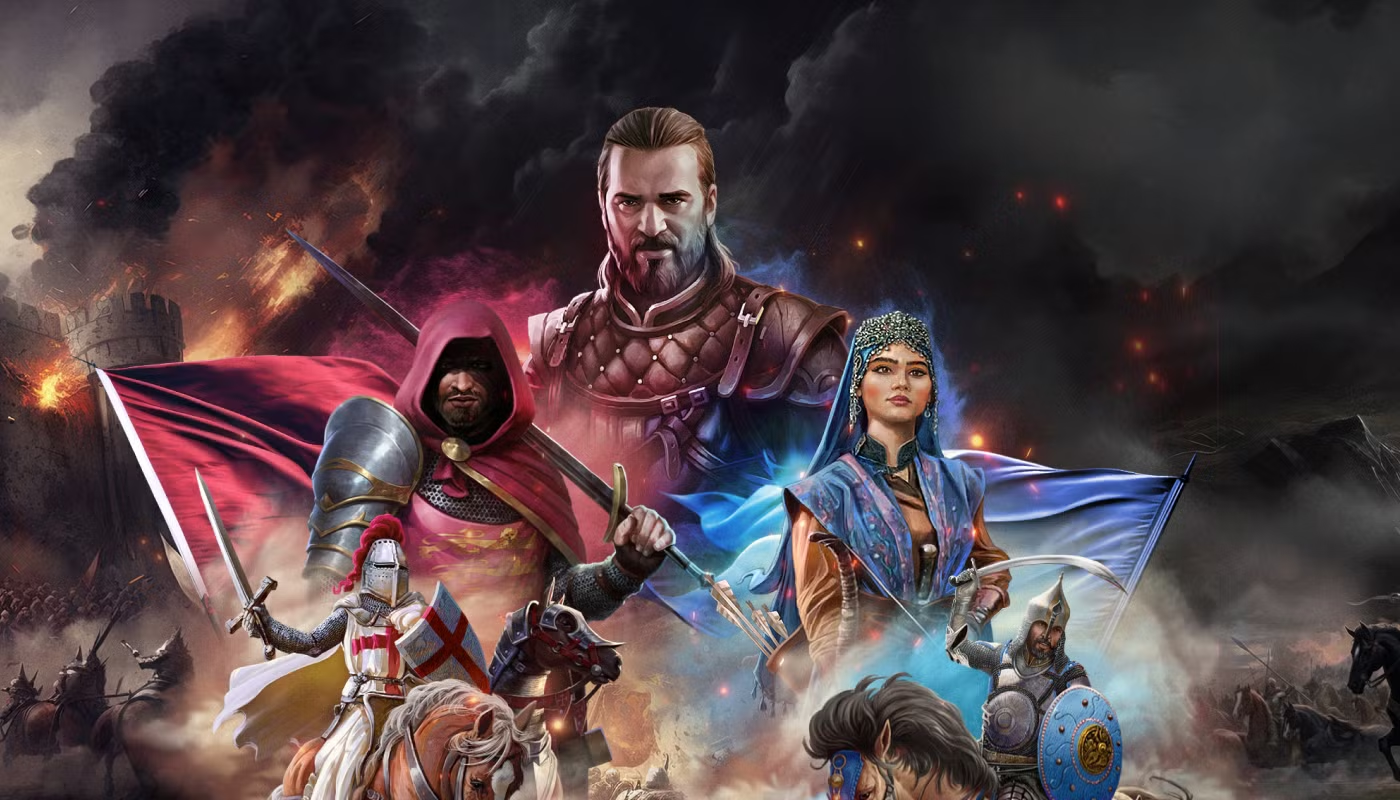
The Medieval Empires blockchain strategy game sends players back to the late 13th century in Turkey. The game is powered by blockchain technology and, offers a rich blend of historical setting and strategic gameplay. We at GMGames had the pleasure to speak with the visionary chief and co-founder Assad of Medieval Empires about the game’s development, its unique features, and the future of blockchain gaming
Medieval Empires A New Era of Blockchain Strategy Games
Shuab (GMGames editor-in-chief): What inspired the creation of Medieval Empires, and how did you choose the historical setting and characters?
Assad (Medieval Empires Co-founder): The inspiration for Medieval Empires came from recognizing the potential for change in the gaming industry. Every few years, there’s a platform shift in gaming, like the rise of mobile gaming or social gaming on Facebook. We saw blockchain technology as the next big shift, primarily due to its ability to introduce true ownership in games.
We believe that ownership of assets will transform how we see and interact with games. Lets say there are over 3.5 billion gamers worldwide who spen significant time and money on games, the concept of actually owning their in-game assets is something new. In the digital world, we’ve moved from owning everything to owning nothing, with subscription models becoming the norm. Bringing back ownership to the digital world, especially in games, is such a huge thing that we believe it will be the new normal in 5 years.
Shuab: What have you done differently that makes you stand out from other games?
Assad: To make our game stand out, we partnered with a famous Turkish actor, Engin Altan Düzyatan. He is very famous in Turkey and known for his roles in historical dramas. This strategy helps us bring in a large, existing fanbase [of his] and reduces user acquisition costs. The historical setting naturally followed from this partnership, allowing us to create a rich, engaging world based on the 13th-14th century Turkish and English crusader factions.
Shuab: That’s a fascinating approach. Can you share some of your team’s main challenges while developing Medieval Empires and how you overcame them?
Asad: One of our primary challenges was assembling the right team. It was crucial to have experienced professionals from the gaming industry who could create a truly engaging game. We needed to convince senior people from the gaming industry to join us in this blockchain venture, which was initially met with skepticism.
I approached them with a challenge: to use their expertise to create a blockchain game that works, giving them the opportunity to shape the future of gaming. This approach helped us attract talent from big gaming studios.
Shuab: How did they take to the constant change within web3 gaming?
Assad: Yes, that is true. Understanding the Web3 space, which is still evolving, was another significant challenge. The sentiment and ideas in the blockchain community change every few months, so we needed people who could stay on top of these trends and educate the rest of the team.
Funding was also challenging, especially as we started when the bear market began. However, our strategy of having big crypto influencers and a famous actor on board helped us secure funding even in difficult market conditions.
Gameplay and Features
Shuab: Can you explain more about the gameplay and features of Medieval Empires?
Assad: Medieval Empires is a story-based, mid-core strategy game. It’s designed as a mobile game, but we started with a desktop version due to initial uncertainties about mobile regulations for crypto games. The game offers a mix of short and long play sessions, catering to different player preferences.
The game has three main views:
- World Map: This shows different counties or lands that players can buy on OpenSea. Higher-level lands offer special benefits and unlocks.
- Province Map: This is where players manage their own land, assemble armies, fight invaders, and gather resources.
- Town View: This is where players build and upgrade various structures in their town, similar to a city-builder game.
One unique feature is the land ownership system. Landowners can tax other players who settle on their land, creating an additional revenue stream. We also have a durability system for heroes, where heroes have a limited lifespan but can pass on their legacy to new heroes.

Shuab: I love the idea and the mechancis of the of the durability system, the limited life space and passing on their legagcy is truly something that is insightful looking at blockchain data. When it comes to goals, what are the short-term, mid-term, and long-term goals for players in Medieval Empires?
Assad: Short-term goals include completing daily missions to earn rewards, assembling armies, defeating invaders, and leveling up heroes. Mid-term goals focus on upgrading the player’s town and achieving higher-level structures. Long-term goals are more centered around land ownership, maintaining active players on your land to increase its prestige level, and unlocking special enhancements.
We’re continually adding new features. In the coming months, we’ll introduce player-vs-player combat, new factions like the English Crusaders, and more NFT integrations for items like hero gear.
Blockchain Integration and Tokenomics
Shuab: Let’s talk about the blockchain integration. I believe it’s on Polygon, is that correct?
Assad: We started with Polygon for our land NFTs and our token. However, we’ve formed a close partnership with Immutable X zkEVM. We’re transitioning to Immutable X because it’s a fast and cheap blockchain with a strong focus on gaming. They provide excellent support and understand our specific needs as a gaming project.
Shuab: Tell us more about the $MEE token. How does that fit within the ecosystem?
Assad: The $MEE token serves several purposes in our ecosystem:
- Staking for VIP status: Players can stake $MEE tokens to gain VIP levels, which provide extra benefits in the game.
- Temporary land ownership: Players who don’t own land can stake $MEE tokens to temporarily gain land owner benefits.
- Rewards: $MEE tokens are given as rewards for various in-game activities and leaderboard challenges.
In the future, we plan to expand the token’s utility. It will become the premium token for high-value transactions within the game. We’re also introducing a separate silver token for more common in-game transactions.
As for other NFTs, we currently have land NFTs, and we’ll soon introduce NFT commanders, hero NFTs, and unit NFTs. These will all play crucial roles in the game’s economy and player ownership system.
Future Developments and Roadmap
Shuab: Can you share with us the key items on your roadmap for Medieval Empires?
Assad: Absolutely. We have an exciting roadmap ahead:
- NFT Commanders: This is our next major release, coming soon on Immutable X.
- PvP Mode: We’re introducing player-vs-player combat in Q3.
- P2P Trading: Also planned for Q3, allowing players to trade in-game assets directly on the blockchain.
- New Faction: The English Crusaders will be introduced in Q4, aimed at attracting more Western players.
- Mobile Version: By the end of the year, we plan to release our first mobile version. This is a significant milestone for us.
The mobile release is particularly important because in many countries where our partnered actor is famous, mobile penetration is much higher than PC. This will allow us to reach a much broader audience and showcase that Medieval Empires is primarily a mobile game.
Shuab: That’s a rich roadmap and a big mielstone regarding the mobile release. Are there any other developments you’re particularly excited about?
Assad: We’re also working on integrating more NFT elements into the game. Soon, we’ll have NFTs for hero gear, different parts of equipment, and more. Our goal is to have true ownership for nearly everything in the game.
Another exciting aspect is our plan to continually add new factions based on user interest. For example, if we see significant interest from Chinese players, we could introduce a Chinese faction with its own unique land, heroes, and historical context. This gives us endless possibilities for expansion and keeps the game fresh for years to come.
Industry Trends and Medieval Empires’ Role
Shuab: How do you see the blockchain gaming industry evolving, and what role do you think Medieval Empires will play in this evolution?
Assad: I believe we’re on the verge of seeing many high-quality blockchain games appear, probably starting next year. The investments made in the crypto space 2-3 years ago are finally bearing fruit in terms of game development.
We’re also seeing rapid improvements in blockchain technology to enhance user experience. Projects like Immutable X are making it easier for players to enter Web3 games without needing to understand the underlying technology.
Mobile is going to be a major trend. With Google becoming more open to blockchain games and Apple likely to follow, I expect we’ll see a surge in mobile Web3 games in the next 1-2 years. Medieval Empires aims to be at the forefront of this mobile blockchain gaming revolution.
AI is another significant trend. We’re already using AI for creating content, marketing, and even for in-game NPCs. In the next 2-3 years, AI could dramatically change game development, potentially allowing smaller teams to create high-quality games.
Shuab: What aspect of these developments are you most excited about?
Assad: Personally, I’m most excited about the potential for true digital ownership in the next 5-10 years. Imagine a future where we have AR glasses providing a digital overlay of our world. People could showcase their digital assets – like unique skins or items from games – in the real world. This combination of AR, the digital world, and blockchain-based ownership is incredibly exciting.
For Medieval Empires specifically, I’m looking forward to potentially bringing the game into AR, allowing players to see historical characters and settings overlaid on the real world. It’s about bringing history to life in an interactive, immersive way.
Team and Funding
Shuab: Can you tell us about your team at the moment?
Assad: We currently have a team of 32 people. It’s a diverse group with various skill sets essential for game development. We have artists, concept artists, developers, and smart contract specialists. Our team is structured into several key departments:
- Art team: Responsible for the visual aspects of the game
- Tech team: Includes blockchain developers and backend developers
- Product team: Oversees product vision and execution
- Marketing team: Handles our promotional and community engagement efforts
We also have myself as the co-founder and chief visionary officer, along with other executives handling operations.
Shuab: That’s an impressive team size. Who are your biggest backers at the moment?
Assad: Interestingly, all our funding has come from private individuals who believe in our vision. We’ve never raised money from VCs. We’ve shared our story with family, friends, and other private investors who see the potential in what we’re building. To date, we’ve raised more than $7.5 million over the last two years, all from these private backers.
Leadership and Vision
Shuab: As a co-founder and visionary, what are your personal goals for Medieval Empires?
Assad: My primary goal is to push for ownership in games. I fundamentally believe that this will change not just the gaming industry, but many other industries as well. Coming from a background in healthcare, I see how blockchain and data ownership could revolutionize that sector too.
I want to be part of this significant change in the digital world. As someone with experience in change management and digital transformation in global companies, I want to drive this transformation in the gaming industry.
With Medieval Empires, we have a great product and an excellent team to make this vision a reality. We’re not just creating a game; we’re participating in a major digital transformation.
Shuab: How do you balance the responsibilities of being a leader in the company with your creative vision for the game?
Assad: In the volatile crypto space, it’s crucial to have leaders who remain calm and provide a positive outlook, especially during bear markets. As a visionary leader, my role is to make our team believe in the vision and stay motivated, regardless of market conditions.
I attend many conferences and gather feedback from the community, which I then share with our team. This helps keep everyone motivated and aligned with our long-term goals. It’s about creating a shared vision and constantly reinforcing why what we’re doing is important and exciting.
In a transformative project like this, you need someone who truly believes in the vision and can inspire the team to make it happen. That’s the role I strive to fulfill as a leader in our company.
Wrapping Up
Medieval Empires brings an air of maturity to blockchain gaming. By enabling blockchain technology, principles such as digital assets ownership, and gameplay mechanics coupled with strategic partnerships and visionary leadership, the game aims to bridge the gap between traditional gaming and the world of Web3. The team’s commitment to continual improvement and expansion, together with their understanding of both gaming and blockchain technologies, positions Medieval Empires as a front-runner within the blockchain gaming space. As the project moves forward with its ambitious roadmap – including mobile release, new factions, and deeper blockchain integration – it will be fascinating to watch how it shapes and is shaped by the evolving landscape of blockchain gaming. With Medieval Empires, it feels the team is not just creating a game but participating in a digital transformation that could redefine our relationship with virtual worlds and digital assets. As the lines between gaming, blockchain, and augmented reality continue to blur, projects like Medieval Empires may well be paving the way for the future of interactive entertainment.